NEW YORK, NY

McDonald's CEO Chris Kempczinski vs Burger King President Tom Curtis
The viral Big Arch burger video saga reached its next chapter this week. If you missed the backstory: in late February, Kempczinski posted to his Instagram a staged, fluorescent-lit video of himself "trying" the new Big Arch burger with all the enthusiasm of a man sampling a lab specimen. The internet was merciless. He took a tiny, guarded bite, described the product like an investor deck, and handed competitors a gift. (Read my full burger-inspired exec brand building lesson here).
This week, Kempczinski broke his silence in an exclusive Wall Street Journal interview. His approach is to lean into the self-deprecation. He blamed the cautious bite on his mother ("she taught me not to talk with my mouth full"), claimed he eats McDonald's 3-4 times a week, and took on-camera bites of fries and nuggets to prove his point.
It's an improvement, I'll give that to Chris K. He came across more human and less like a boardroom bot. His Instagram following is up 30%, and company reps say Big Arch sales are above expectations. The controversy may have accidentally done his personal brand a favor in spite of the original video, not because of it.
On the other side of the burger battle, Burger King's President Tom Curtis had already made his move weeks earlier. BK surfaced footage of Curtis taking a full, genuine, mayo-on-the-face bite of a Whopper in what appeared to be an actual test kitchen. BK denied it was a direct response, but the timing and framing were too clean to be coincidental. The results were significant: Burger King appeared in 68% of online conversations about the McDonald's video, and restaurant foot traffic rose 7.4% week-over-week. Curtis didn't have to say a word about his competitor, the contrast said everything.
The lesson:
Authenticity isn't about being unpolished, it's about not appearing to perform authenticity. Curtis eating a burger in a kitchen beats Kempczinski eating a burger in a boardroom every time. The mayo on Curtis's face was worth more than any brand consultant's memo.
A study published this week by Cardinal40 and reported by Axios dropped a number that belongs in every C-suite brand conversation and validates my personal career choices: high-quality CEO thought leadership drives an average of $367 million in shareholder value in a single week, independent of product announcements or financial disclosures. The researchers analyzed 1,000+ thought leadership pieces from S&P 500 companies, used AI to benchmark them against a "canon" of standout executive communications, and found a direct correlation between semantic quality and abnormal stock returns. The words themselves move markets.
The implication for the stories below: every exec who fumbled a public moment this week didn't just have a bad PR day. They left money on the table.
Altman dropped what might be the most ambitious CEO thought leadership play of 2026 this week. OpenAI published a 13-page policy paper — "Industrial Policy for the Intelligence Age: Ideas to Keep People First" — calling for robot taxes (essentially, a policy idea where companies are taxed on the economic value produced by automated systems or AI agents, treating automation the way you'd treat a human worker for tax purposes), a 4-day work week, wealth redistribution funds, and AI regulation frameworks modeled on the New Deal.
This is Altman doing what he does best: positioning himself as the person who both builds the thing that could break the world AND proposes the fix. He's simultaneously the fire and the fire department.
Critics are calling the policy paper cover for "regulatory nihilism" — arguing that OpenAI's proposed frameworks are designed to look responsible while giving them space to operate with minimal oversight. A New Yorker profile this week asked the question bluntly: "Can he be trusted?" Altman's brand is built on being the Reasonable Tech CEO, and that positioning is getting stress-tested at scale.
Whether you buy the sincerity or not, Altman owns the conversation about AI's societal impact this week. That's brand-building at the highest level.
Ryan Roslansky, LinkedIn CEO — The 5 Cs Framework
Platform: CNBC / Book Launch | Verdict: Credible and Timely
LinkedIn CEO Ryan Roslansky went on CNBC to name five human skills he says AI cannot replace — curiosity, courage, creativity, compassion, and communication — calling them the "5 Cs." The piece, tied to his co-authored book Open to Work: How to Get Ahead in the Age of AI, positions him as a credible authority on the exact anxiety his platform was built to resolve. It's notable precisely because he doesn't dodge the tension: he's the CEO of a professional network that could be rendered irrelevant if AI replaces human hiring decisions, and he's publicly arguing why it won't be. The credibility is structural — he's using LinkedIn's own labor market data as the source material.
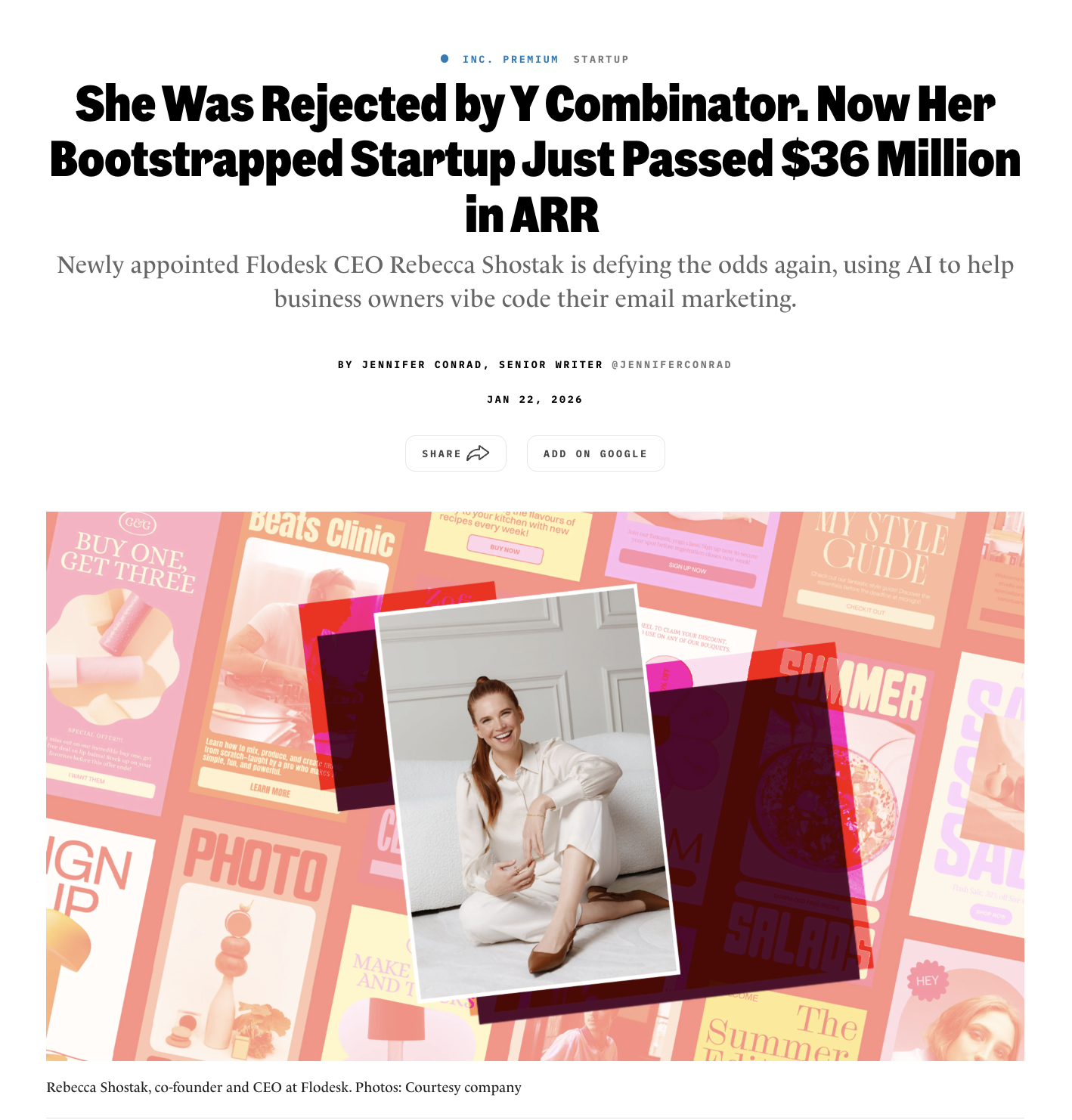
Rebecca Shostak, Flodesk — Bootstrapped, recognized, saying very little
Platform: Earned Media | Verdict: Let the numbers do the talking
Flodesk co-founder and CEO Rebecca Shostak was named to Inc.'s 2026 Female Founders 500 list this week. The brand story underneath the recognition is a company bootstrapped entirely to $36M ARR, 100,000+ customers, 13 billion emails sent last year, $33M in revenue generated for customers through the platform. The founder's background designing for Linkin Park and Rihanna gives the company a design credibility that's rare in the SaaS email space.
What she's doing right: she's not claiming anything. The numbers claim it for her. The Inc. recognition is validation she didn't have to manufacture. A VC-backed competitor burning through runway to hit the same metric would struggle to replicate this story.
Claire Vo, ChatPRD — Nine AI agents and a masterclass in showing your work
Platform: Lenny's Podcast + Newsletter | Verdict: Niche-Defining
Three-time CPTO Claire Vo published an essay and podcast episode on Lenny's Newsletter/Podcast titled "From skeptic to true believer: How OpenClaw changed my life" — describing how she now runs nine specialized AI agents across her business and personal life: a salesperson, a business ops manager, a family assistant, a kids' education agent, and more. The agents run on Mac Minis and old laptops. She went from skeptic (the tool deleted her family calendar on the first try) to full convert, and her takeaway was direct: "It has changed my life."
What makes this a strong executive brand move: it's not a position paper or a hot take. It's a detailed operational disclosure with enough specificity to be immediately useful — what she set up, what broke, what stuck. Vo reaches nearly 55,000 followers on LinkedIn and ranks in the Top 1% of product management creators globally. Her How I AI series means this landed in an established context, not as a one-off provocation.
Nikhil Rana, Founder — The 15 (networking platform)
A Gurugram-based startup founder fired an employee over WhatsApp this week because the employee said they couldn't attend an in-person event but could support remotely. The founder's reply: "You're fired. Take today as the last day." Then he posted the screenshot on LinkedIn, paired with a manifesto about his "no-notice period" policy, explaining that notice periods are "theatre" and "a waste of time." He also declared: "Skills have taken the last seat now. Nobody gives a dime for skills."
The post went viral for exactly the wrong reasons. The comments were uniformly critical, with users noting that "decisions without context don't signal high standards — they signal unpredictability." Several called it "another founder who thinks he's God."
This is a recurring LinkedIn fail pattern: founders confusing "controversial = bold leadership" with "controversial = bad judgment on display." The post tells potential employees, investors, and partners a clear story — just not the one the founder intended. Or is it? We're talking about him, after all.
Roy Lee, Co-Founder & CEO — Cluely (AI startup)
This one broke in early March but is still circulating in April as a case study in what not to do. Roy Lee, CEO of Andreessen Horowitz-backed Cluely, admitted on X that he lied to TechCrunch about the company's ARR — claiming $7M when the real figure was $5.2M. Rather than managing this quietly, Lee then posted an expletive-filled rant firing back at the coverage.

Cluely started as an AI tool that helped people cheat on job interviews. Its rebrand to "AI-powered meeting note-taker" was already fragile and the revenue fabrication story confirmed every skeptic's narrative about the founder's character.
Lee's rant after the admission — rather than a measured response — turned a damaging story into a defining one. Investors and enterprise clients now have a data point they can't un-see. The "unapologetic founder" persona works when you're building in public. It doesn't work when you're explaining why you lied about your numbers.